Onion is one of the most profitable crops a small farmer can grow and one of the most punishing. Prices swing violently, and the difference between a good year and a bad one is often not the crop but the week you sold it.
Which makes storage as important as cultivation in this crop.
Nursery
- Raise seedlings on beds raised above the surrounding level for drainage
- Apply well-decomposed farmyard manure to the bed
- Do not sow too densely — crowded seedlings are thin and transplant poorly
- Transplant at the recommended seedling age for your variety. Over-age seedlings bolt more readily
Damping off is the main nursery problem, caused by excess moisture and poor drainage. Raised beds and controlled watering prevent most of it.
Transplanting and Spacing
Onion has a shallow root system and does not compete well with weeds. Line planting at the recommended spacing allows mechanical weeding and produces more uniform bulbs.
Spacing affects bulb size directly. Wider spacing gives larger bulbs; closer spacing gives more, smaller bulbs. Choose according to what your market pays for — some markets pay a premium for medium uniform bulbs rather than the largest.
Nutrients
Onion responds strongly to sulphur, which affects pungency, and to potassium, which affects bulb quality and storage life. Sulphur-deficient onions store poorly, which is a cost that appears months after the deficiency.
Excess nitrogen late in the season delays maturity, produces thick necks, and gives bulbs that rot in storage. Nitrogen should be tapered off as bulbing begins.
Water — and When to Stop
Onion needs consistent moisture during bulb development. Irregular irrigation — alternating stress and flooding — causes splitting and doubles.
Stop irrigation two to three weeks before harvest. This is the most commonly ignored instruction in onion cultivation. Irrigating close to harvest produces bulbs with high moisture content that rot in storage. Farmers who lose half their stored crop usually irrigated too late.
Harvest Timing
Harvest when about half to three-quarters of the tops have fallen over naturally. Harvesting earlier gives thick necks that do not cure; harvesting much later risks sprouting and splitting.
Lift the bulbs and leave them in the field in windrows with the tops covering the bulbs, protecting them from direct sun.
Curing — The Step That Decides Storage Life
Curing dries the outer scales and the neck, forming the barrier that keeps the bulb sound in storage. It is not the same as leaving onions in the sun.
- Field cure for a few days with tops covering bulbs
- Then shade cure for two to three weeks in a ventilated space
- The neck should be fully dry and tight before storage
- Direct hot sun causes sunscald, which shows later as soft patches
Cut tops leaving a short stub. Cutting too close to the bulb opens an entry point for rot.
Storage Structure
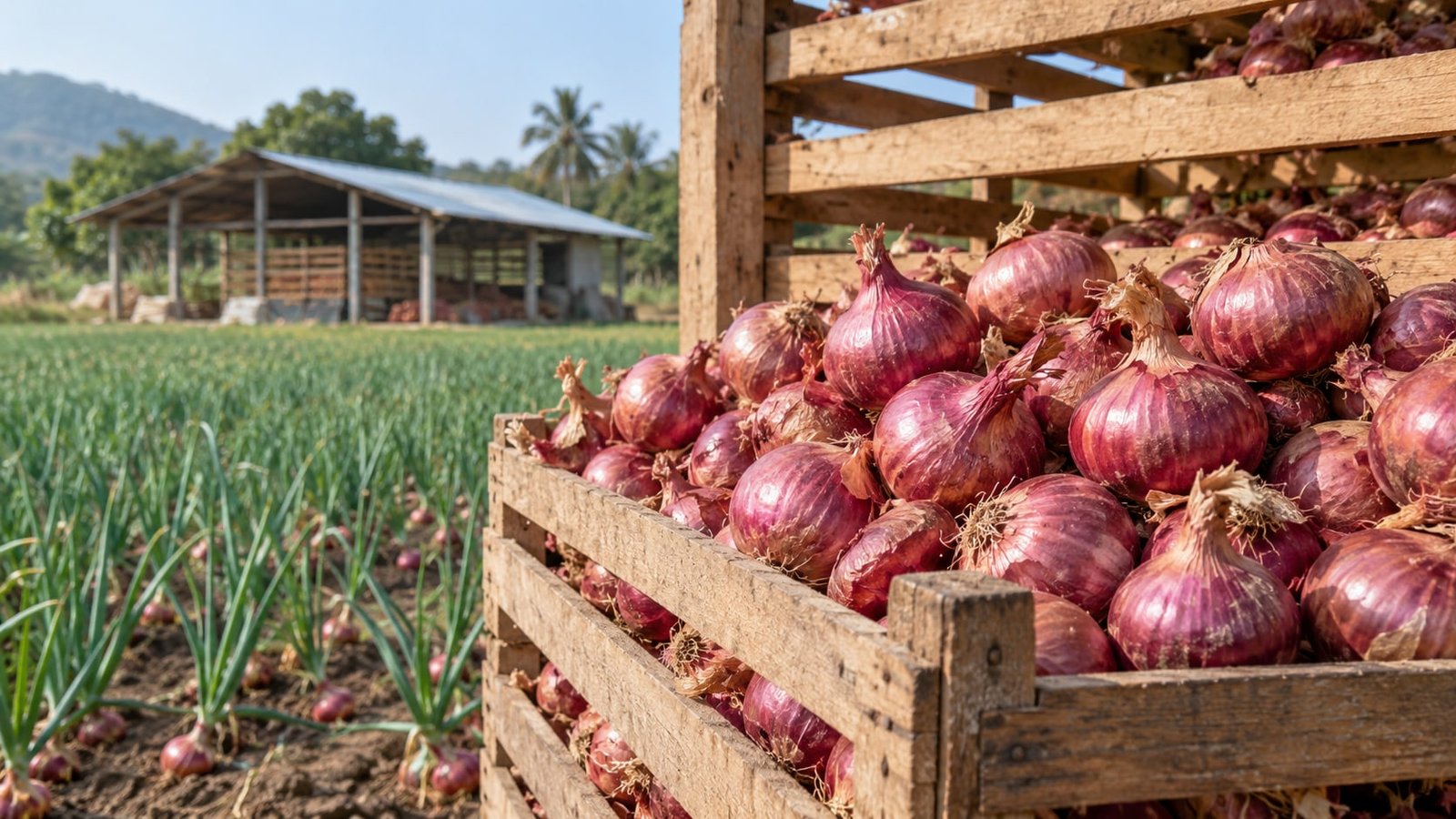
A proper onion storage structure has:
- Bottom ventilation — a raised slatted floor so air moves through the pile from below
- Side ventilation — slatted or mesh walls
- Shade — a roof that keeps direct sun off but allows airflow
- Limited pile depth — deep piles heat in the middle and rot from inside
Subsidy for onion storage structures is available in many states under horticulture programmes. Ask your district horticulture officer what is currently available.
Grading Before Storage
Remove and discard any bulb that is split, thick-necked, damaged or showing soft spots. One rotting bulb spreads through a section of the pile. Sell these immediately rather than storing them.
Inspect stored onions every two to three weeks and remove any that have started to rot.
The Price Problem
Onion prices routinely collapse at peak harvest and recover months later. A farmer who must sell at harvest sells into the weakest market of the year, every year.
Storage is what breaks that cycle, and it is why the curing and storage sections above matter more than they appear to. A farmer who can hold produce for three months in good condition is in a fundamentally different position from one who cannot.
Check rates across multiple mandis before selling — the Agmarknet portal and e-NAM both show current prices at different markets, and onion prices vary widely between them.
Varieties, spacing, nutrient doses and storage designs vary by region and season. Consult your Krishi Vigyan Kendra or district horticulture office for local recommendations.